
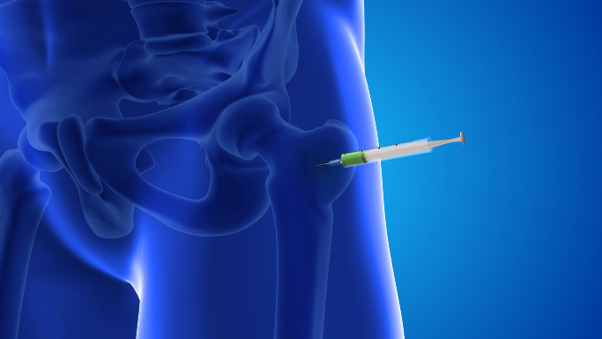
A few millimeters may not sound significant until you're talking about a hip injection. Unlike more accessible joints, the hip sits deep beneath layers of muscle, making precise needle placement surprisingly challenging. Discover why specialists increasingly rely on imaging technology to improve accuracy and give treatments the best opportunity to work.
Why the Hip Is Such a Difficult Target
Unlike a knee or shoulder, the hip joint cannot be reliably located through palpation alone. It sits several inches beneath the skin, surrounded by major muscles, nerves, and blood vessels, with no easily felt bony landmark marking the exact location of the joint capsule. This depth and the proximity to neurovascular structures are precisely why injections guided only by anatomical landmarks carry more room for error than injections elsewhere in the body.
What the Accuracy Numbers Actually Show
The gap between guided and unguided hip injections is not subtle. Landmark-based, or blind, hip injections have reported accuracy rates ranging from roughly 50 to 80 percent, depending on the technique and the experience of the clinician performing it.¹ Image-guided injections, by contrast, have been shown in multiple studies to reach accuracy rates between 97 and 100 percent.² That difference means a substantial share of blind hip injections may never actually reach the joint space at all, delivering medication into surrounding muscle or soft tissue instead of the site it was intended to treat.
Ultrasound Versus Fluoroscopy: Different Tools, Similar Precision
Both ultrasound and fluoroscopic guidance dramatically outperform blind technique, though each comes with its own tradeoffs. A comparative study found that patients strongly preferred ultrasound guidance over fluoroscopy, rating it significantly more convenient and less painful, while both methods achieved comparably high accuracy.³ Fluoroscopy involves radiation exposure and contrast dye but offers excellent bony detail, while ultrasound avoids radiation entirely and allows real-time visualization of soft tissue as the needle advances. The right choice often depends on the specific structure being targeted and the clinical question being answered.
Why Precision Becomes Even More Important With Advanced Treatments
Accuracy matters for every type of hip injection, but it becomes especially consequential as treatment options grow more specialized, and research shows the benefit of these treatments is far from uniform. A prospective study evaluating platelet-rich plasma added during hip arthroscopy for labral tears found that PRP did not improve outcomes compared to a standard control injection, with the PRP group actually reporting slightly higher pain scores at two years.4 A separate randomized trial testing PRP during arthroscopic surgery for femoroacetabular impingement likewise found no meaningful difference between PRP and a saline placebo at two years.5
The picture looks different outside the operating room, however. A pilot study of PRP injections for early-stage hip osteoarthritis, where the joint space was still well preserved, found promising improvements in pain and function, and separate reviews have found PRP favorable for extra-articular conditions like greater trochanteric pain syndrome and hamstring injuries.6 Viscosupplementation has produced similarly mixed results in clinical trials for hip osteoarthritis.7 Across all of these findings, one theme holds steady: precise delivery into the intended target, whether that is the joint space or a specific soft tissue structure, is foundational to giving any treatment, and any research evaluating it, a fair chance to show a true effect.
The Bottom Line on Injection Precision
A few millimeters might sound trivial, but in a joint as deep and densely surrounded as the hip, that margin is often the difference between a treatment that reaches its target and one that does not. Whether the injection involves a standard corticosteroid, hyaluronic acid, platelet-rich plasma, or another regenerative option, image guidance gives both the patient and the clinician confidence that the treatment actually went where it was supposed to go.
If you are considering a hip injection of any kind, it is worth asking how that injection will be guided and confirmed before the appointment, since that detail can shape the outcome as much as the treatment itself.
Frequently Asked Questions
- 1. Are blind hip injections less accurate than image-guided ones?
Yes. Studies have found that landmark-guided hip injections succeed in reaching the joint space roughly 50 to 80 percent of the time, compared to 97 to 100 percent accuracy with image guidance.8 - 2. What is the difference between ultrasound and fluoroscopy for hip injections?
Ultrasound uses real-time sound wave imaging and avoids radiation, while fluoroscopy uses live X-ray imaging and offers excellent visualization of bone. Both have demonstrated high accuracy compared to blind technique. - 3. Does PRP work better than hyaluronic acid for hip osteoarthritis?
Research comparing the two has produced mixed results, with some studies favoring PRP for longer-lasting pain relief and others finding no significant difference, so individual factors often guide which option makes sense. - 4. Why does injection accuracy matter more for regenerative treatments like PRP?
Regenerative treatments are designed to act directly within the joint space, so if the injection misses that target, the treatment has little opportunity to produce its intended effect regardless of what is being injected. - 5. Is viscosupplementation effective for hip osteoarthritis?
Clinical trial evidence on hyaluronic acid injections for hip osteoarthritis is mixed, with some studies showing modest short-term benefit and others finding no significant difference compared to placebo.
Reference Links:
- Ultrasound-Guided Intra-articular Hip Injections - NYSORA
- Longitudinal antero-inferior approach for ultrasound-guided hip joint injection - PubMed Central
- Ultrasound-guided hip injections: a comparative study with fluoroscopy-guided injections - PubMed
- Clinical results of hip arthroscopy for labral tears: a comparison between intraoperative platelet-rich plasma and bupivacaine injection - PubMed
- Peri-operative platelet-rich plasma in arthroscopic femoroacetabular impingement surgery: a randomized controlled trial - PubMed Central
- The effect of platelet-rich plasma in patients with early hip osteoarthritis: a pilot study - Journal of Hip Preservation Surgery
- Viscosupplementation for Hip Osteoarthritis: A Systematic Review and Meta-Analysis of the Efficacy on Pain and Disability, and the Occurrence of Adverse Events - ScienceDirect
- Longitudinal antero-inferior approach for ultrasound-guided hip joint injection - PubMed Central
AUTHOR: Benjamin D. Kuhns, MD, MS – Orthopedic Hip Surgeon & Research Director
Benjamin D. Kuhns, MD, MS is a board-certified orthopedic surgeon and Director of Research at the American Hip Institute in Des Plaines and Chicago, Illinois. He specializes in comprehensive hip care, including hip preservation, arthroscopy, open osteotomies, and primary and revision anterior approach hip arthroplasty. Dr. Kuhns also incorporates regenerative medicine techniques into personalized treatment strategies designed to restore function and accelerate return to activity.
Credentials & Recognition
Dr. Kuhns completed his Bachelor of Arts at Colgate University with a major in chemistry and a minor in history, followed by a Master of Science in Neuroscience from Northwestern University. He earned his medical degree from Case Western Reserve University School of Medicine, graduating with distinction in research and being inducted into the Alpha Omega Alpha honor society. He then completed orthopedic residency training at the University of Rochester Medical Center, where he received the Kenneth DeHaven Research Award for work linking femoroacetabular impingement to hip osteoarthritis. Following residency, Dr. Kuhns pursued fellowship training in adult hip preservation and reconstruction at The Steadman Clinic and completed advanced hip preservation training at the American Hip Institute. He has authored more than 40 peer-reviewed articles and book chapters on hip dysfunction and surgical management.
Clinical Expertise
Dr. Kuhns’ clinical focus includes non-operative management of hip pain through targeted physical therapy and injections, complex primary and revision hip arthroscopy, open hip preservation including periacetabular and femoral osteotomies, and robotic anterior approach total hip arthroplasty. In his role as a surgeon and researcher, he collaborates closely with patients to craft customized treatment plans aimed at optimizing functional outcomes and helping individuals return to the activities they enjoy, regardless of age. He is an active member of professional organizations, including the American Academy of Orthopaedic Surgeons and The Hip Preservation Society (ISHA).
Medical Disclaimer: This information is for educational purposes only and does not constitute medical advice. For diagnosis and treatment recommendations, please consult with Dr. Kuhns or another qualified orthopedic specialist at the American Hip Institute.
AUTHOR: Dr. Etan P. Sugarman, MD, FAAOS - Orthopedic Joint Preservation & Sports Medicine Surgeon
Dr. Etan P. Sugarman is a board-certified orthopedic surgeon specializing in joint preservation, hip arthroscopy, sports medicine, and hip replacement at American Hip Institute & Orthopedic Specialists. He serves as Director of Joint Preservation and focuses on advanced, minimally invasive solutions to restore function and help patients return to active lifestyles.
Credentials & Recognition
Dr. Sugarman graduated with honors from New York University and completed his orthopedic surgery residency, where he graduated at the top of his class and was inducted into the prestigious American Orthopaedic Association (AOA).
He completed fellowship training in orthopaedic sports medicine at the Kerlan-Jobe Orthopaedic Clinic. He also completed advanced training in hip arthroscopy, preservation, and reconstruction at the American Hip Institute Research Foundation under the mentorship of Dr. Benjamin Domb.
Dr. Sugarman served as clinical and educational faculty at Lenox Hill Hospital in New York City for nearly a decade. He is a Fellow of the American Academy of Orthopaedic Surgeons (FAAOS) and has received multiple awards recognizing his contributions to orthopedic research and education.
Clinical Expertise
Dr. Sugarman specializes in the full spectrum of joint preservation and sports medicine, including hip arthroscopy for femoroacetabular impingement and labral tears, minimally invasive joint preservation procedures, and hip replacement. He also treats complex shoulder and knee conditions using advanced arthroscopic and reconstructive techniques.
He has developed innovative surgical techniques in hip and shoulder surgery and is actively involved in teaching advanced joint preservation procedures to orthopedic surgeons worldwide.
Dr. Sugarman has treated professional and elite athletes from organizations including the NFL, MLB, NHL, NBA/WNBA, MLS, and Division I collegiate programs, as well as Olympic athletes. He has authored over 100 publications and presentations and is dedicated to advancing the field of joint preservation and sports medicine.
Medical Disclaimer: This information is for educational purposes only and does not constitute medical advice. For diagnosis and treatment recommendations, please consult with Dr. Sugarman or another qualified orthopedic specialist at American Hip Institute & Orthopedic Specialists.
Content authored by Dr. Etan P. Sugarman and verified against official sources.